Any industrial structure, be it a manufacturing facility or a multistory warehouse, is a result of many decisions that are made years ahead of its roof installation. One of the most important of these decisions involves the selection of the metal decking, which is the key element of composite flooring, platforms, and roof decks. The correct choice will give you fast, durable performance for many years to come. A wrong choice will bring you problems with deflections, corrosion, and unnecessary expense. This article discusses the elements you should consider when selecting your deck.
Key factors to consider when choosing metal decking:
- Structural application (roof or floor)
- Span requirements
- Profile depth and gauge
- Steel grade and coating
- Composite floor performance
- Compliance with industry standards
- Fire and acoustic performance
- Site logistics and technical support
Understand What Metal Decking Does
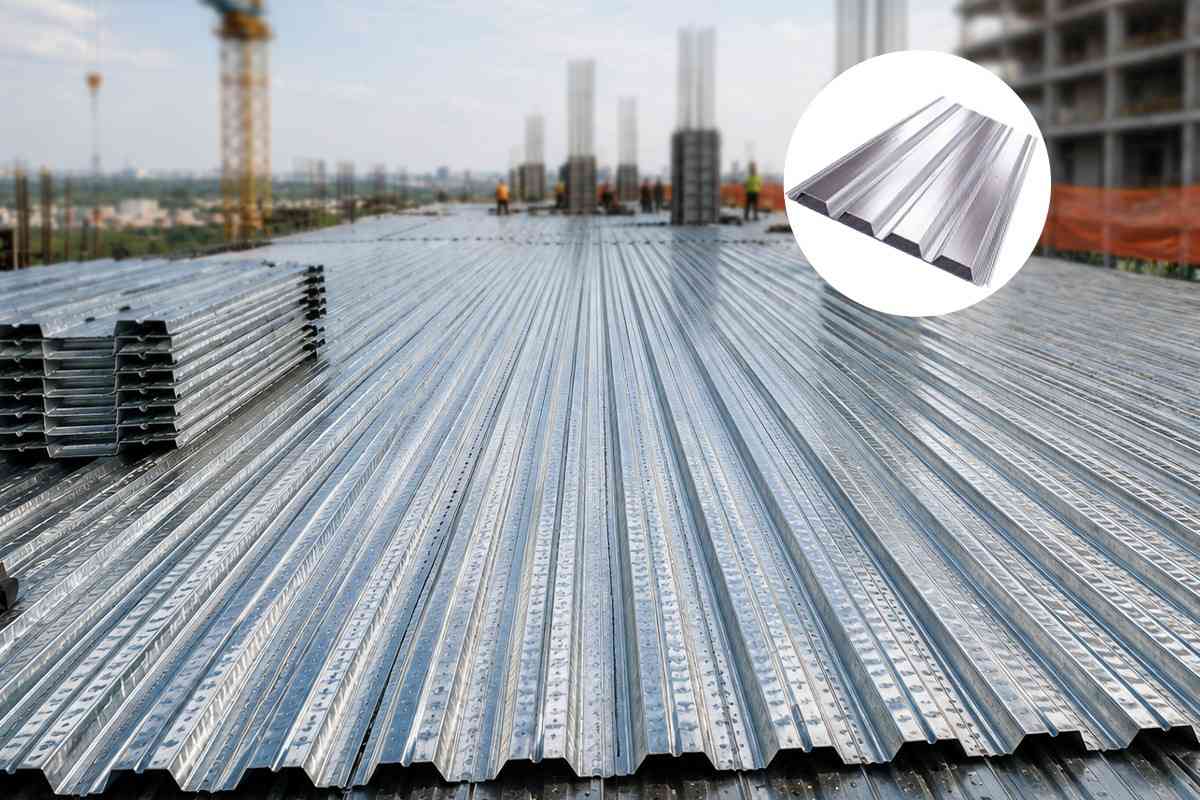
In essence, the steel metal decking is a profiled sheet that is cold formed into shape and has structural significance. The metal deck serves as permanent formwork for the concrete and works with the concrete slab to provide reinforcement as a unit. In roofing applications, it provides the structural substrate over which insulation and waterproofing are built. It takes the working loads directly on the mezzanines and platforms. Since the two tasks have unique requirements for the deck profile, the initial stage of the process involves identifying the function of the deck in your building.
Match the Profile Depth to Your Spans
Profile Depth and Gauge are critical factors for determining how much span a deck is capable of without causing deflections. The deeper the profile with stiffened ribs, the more the span and thus the fewer secondary beams/purlins are required. For industrial buildings with wide column grids, this can meaningfully cut steelwork costs. Always work from the manufacturer’s load-span tables, verified by your structural engineer against the imposed loads of your specific facility, whether that is fork-lift traffic, racking point loads or heavy plant.
Choosing the Right Metal Decking at a Glance
Factor | What to Check | Why It Matters |
Application | Roof or floor | Determines profile type |
Span | Manufacturer load-span tables | Prevents excessive deflection |
Profile depth | Deep vs shallow profiles | Influences structural efficiency |
Steel grade | Yield strength | Higher strength allows lighter construction |
Coating | Zinc or Zinc-Aluminium | Protects against corrosion |
Compliance | AS 1538, BS 5950, IS 875 | Ensures structural performance |
Choose the Right Material and Coating
The most widely produced type of metal deck in steel metal decking is the high tensile steel which is galvanised with either zinc or zinc/aluminium to provide protection against corrosion. This is dependent on the coating grade because where there is humidity, corrosive vapors, or even coastal areas, there is need for thick galvanised coating whose grade is measured in GSM in line with certain recognized specifications such as AS 1397. Ensure that you check for yield strength too, as the higher the grade, the thinner the metal. For projects with unusual exposure conditions, discuss coating options with the manufacturer at design stage rather than after fabrication.
Consider Composite Action for Floors
When the deck constitutes a composite floor using concrete, embossments and rib geometry provide the mechanical connection between the steel and concrete. A good design of the floor decking sheets will mean that there is no requirement for temporary propping when pouring concrete and the slab remains thin. The use of reliable Floor decking sheets saves a great deal of time during construction compared to traditional shuttering. Multi-storey industrial buildings will benefit greatly from such a time saving process.
Check Compliance and Testing
Industrial buildings face regulatory scrutiny, insurer requirements and, increasingly, green building expectations. Request documentation proving the basis of design according to specifications like AS 1538, BS 5950, or IS 875, and material certificates. This will provide extra confidence since an ISO 9001:2015-certified manufacturing process guarantees conformity of all products coming out of the manufacturing plant to the tested specification. The lack of documents is a true warning sign since fixing errors on decks can be extremely costly and hazardous.
Think About Fire, Acoustics and Services
Industrial metal decking decisions ripple into other disciplines. Composite slabs on metal deck achieve good fire resistance ratings when designed correctly, and the deck profile influences how services such as ducting, sprinklers and cable trays are suspended beneath. Trapezoidal voids can also assist acoustic performance in noisy production environments. Bringing your decking supplier into coordination discussions early prevents clashes and costly redesign later.
Factor in Logistics and Site Support
Decking comes in large and bulky bundles, which need to be lifted, dispersed, and installed in an efficient manner. Having an engineering back-up from a manufacturer would help with laying out plans, installation schedule, and advice on-site. Additionally, having local manufacturing would reduce time and avoid importation holdups. For phased industrial developments, confirm the manufacturer can hold consistent profiles and coatings across multiple supply stages.
At LCP Building Products Pvt. Ltd., we manufacture structural steel decking as part of our comprehensive range of roll-formed building products, produced on ISO 9001:2015 certified lines from high tensile, zinc-aluminium coated steel. Our structural decking and framing solutions are supported by our full range of C and Z purlins and girts, with section depths from 50mm to 350mm, zinc coatings of Z120, Z180 and Z275 GSM in accordance with AS 1397, and designs conforming to AS 1538, BS 5950 and IS 875, allowing us to supply the complete structural package for your industrial building from a single source. As the only roofing manufacturer in India with in-house machinery capable of producing profiles in steel, aluminium and titanium zinc, we combine international expertise with accurate engineering design and prompt delivery. Speak to our team to specify the right decking solution for your next project.
The choice of the appropriate industrial metal decking for an industrial building involves matching the depth, grade, and coatings of the chosen metal deck to the spans, loads, and environment of the project, and ensuring that all of the above is certified by testing. It requires consulting with an experienced metal deck producer, and you can be assured of a long lifetime of your deck’s performance.
Leave A Comment